
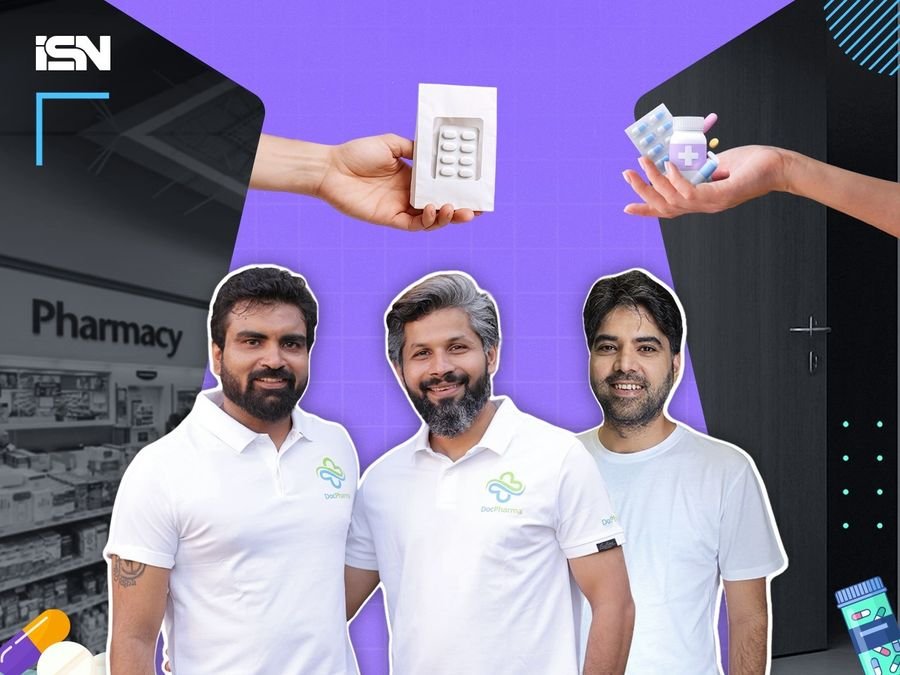
30-minute medicine delivery is reshaping healthcare infrastructure — and Moldova's pharmacy sector should be paying attention
Speed is not the product. Infrastructure is.
India's quick-commerce sector already delivers groceries in 10 minutes and meals in under 30. Yet prescription medicines — the category where delays carry genuine clinical risk — still take two to three days to arrive. DocPharma, a B2B2C startup founded in 2023, is closing that gap by positioning itself not as another pharmacy app, but as the invisible logistics backbone that lets e-pharmacies, insurers, and hospitals offer 30-minute delivery without rebuilding their operations from scratch. Operating across 12 Indian cities, the company fulfils over 80% of orders within 60 minutes across a catalogue of more than 100,000 SKUs.
What makes DocPharma structurally interesting is the bet it made: while competitors built consumer-facing platforms, DocPharma built infrastructure. Its rule engine reads customer location, identifies the nearest partnered pharmacy with complete stock, and dispatches a rider — all without ever exposing customer data to the store. Partners keep full ownership of their clients. The company calls itself the "AWS of medicine delivery," and the analogy holds: the value is in what the end user never sees.
But this story is not about fast delivery. It is about who owns the layer underneath the transaction — and how the business that controls fulfilment infrastructure tends to outlast the businesses it serves.
Moldova's private pharmacy sector operates in a market where the digital-to-physical gap is still wide open. Local pharmacy chains and independent dispensaries fulfill the overwhelming majority of prescriptions through walk-in traffic. Online ordering exists at the edges, and same-day delivery — let alone sub-hour — is not yet a standard expectation among consumers. That is not a criticism. It is a window. The consumer habit of visiting multiple pharmacies per prescription, which DocPharma identified as a core pain point in India, is equally present here. The infrastructure problem is the same; only the scale differs.
For anyone operating in pharmaceutical retail, healthcare services, or last-mile logistics in Moldova, the real test comes down to three things:
Are you building a platform or a pipe? Consumer-facing pharmacy apps capture attention, but the companies that build the fulfilment layer underneath them tend to capture the margin — and the lock-in.
What does your out-of-stock rate cost you in trust, not just revenue? In a market where word-of-mouth drives retention, a single failed delivery lands harder than it would in a high-volume anonymous market. The bounce rate is a reputation number, not just an operational one.
If a healthcare insurer or corporate wellness provider wanted to offer medicine delivery to their members tomorrow, could your operation handle it without rebuilding anything? B2B2C is not a buzzword — it is a distribution question, and Moldova's insurance and corporate health sectors are underserved precisely here.
The infrastructure layer in Moldovan healthcare is still largely unbuilt. The question is not whether someone will build it — it is whether that someone is already in the market today.
SourceSee also

From Rs 15,000 and a 150 sq. ft. room to 8,000 rooftops: what Ksquare Energy's story says about the real edge in emerging markets
The bootstrapped Indian solar company didn't win by being cheap — it won by controlling quality at every layer of the chain.
Ksquare Energy started in 2017 with Rs 15,000 in savings, a rented room in Ahmedabad, and a founder who had just been denied an education loan. Eight years later, the company posted Rs 74 crore in revenue for FY 2023–24, reported 56% year-on-year growth, and has set a target of Rs 225 crore by FY 2025–26. It now covers 23 Indian states, supplies over 650 EPC firms, and ranks among the top 10 vendors under India's PM Surya Ghar Yojana — all without a single rupee of external funding. The numbers are striking. But the mechanism behind them is more instructive than the scale.
Founder Kuldip Sorathiya began as a commission agent reselling third-party solar products. The pivot came not from a strategy retreat, but from field reality: recurring quality failures in cables and components were undermining customer trust. Instead of switching suppliers, he started manufacturing the components himself — ACDBs, DCDBs, cables — and launched the proprietary brand Solsquare. That decision compressed the value chain and gave the company control over quality, delivery timelines, and product iteration. According to Mercom India, rooftop solar installations in India surged 232% year-on-year in Q1 2025, touching over 1.2 GW. Ksquare didn't just ride that wave — it had already built the infrastructure to supply it.
The deeper lesson isn't about solar. It's about the structural advantage of vertical integration in a market where quality is inconsistent and trust is scarce. When the underlying supply chain is unreliable, the business that controls more of it doesn't just reduce costs — it becomes the standard. That pattern appears in every emerging market at a certain stage of development, and Moldova is no exception.
For the Moldovan renewable energy sector — solar installation companies, energy service providers, importers of photovoltaic equipment — the Ksquare story maps onto a familiar set of constraints. Local installers typically depend on imported components whose quality varies by shipment and by supplier relationship. A service guarantee is rare. Post-installation support is often informal. The market is growing, but it is growing on a foundation of inconsistent execution, which means the window for differentiation through reliability is still wide open. This is where it becomes worth asking the right questions rather than drawing easy conclusions. If your business depends on components or inputs you don't control, what happens to your reputation when those components fail? If a competitor offered a formal service guarantee — something equivalent to Ksquare's 5-Year Zero Loss Guarantee — would your current clients stay with you on price alone? And if you have accumulated field knowledge about what fails and why, are you using that knowledge to improve what you offer, or simply absorbing the cost of recurring problems?
Ksquare's trajectory also illustrates something that applies directly to capital-constrained operators: profitability since inception, built through reinvestment rather than fundraising, gave the company the credibility and the leverage to now consider strategic capital on its own terms. That sequence — prove the model first, then open the door to outside money — is available to any operator willing to be patient about scale.
Most businesses in Moldova's energy services space tend to compete primarily on installation price, treating components as a cost variable rather than a quality lever. A more deliberate approach looks like treating field failures as product intelligence — and using that intelligence to build something proprietary, even if it starts small.

The #deinfluencing hashtag has been used over 26,000 times — and it's rewriting the rules of retail everywhere, including Moldova
When consumers start auditing their closets instead of filling them, the business model built on volume starts to crack.
The hashtag #deinfluencing has been used more than 26,000 times on TikTok, filled with content creators actively working to undo the impulsive purchasing behaviour the platform helped create. Alongside it, pledges like the "Rule of 5" — limiting fashion purchases to five items per year — and "no-spend" challenges have moved from niche corners of the internet into mainstream consumer conversation. This is not a temporary mood. At the World Economic Forum in Davos in January 2024, the head of the World Trade Organization, Dr Ngozi Okonjo-Iweala, called on world leaders to "rethink old growth models." The pressure is arriving from both the bottom and the top simultaneously.
The obvious read is that this is a Western phenomenon — a reaction to decades of hyper-consumerism that most Moldovan businesses have not yet experienced at scale. But that framing misses the more uncomfortable insight. The research behind these movements suggests the problem is not abundance itself — it is a business model structurally dependent on perpetual volume growth. Joseph Merz, chairman of the Merz Institute and senior fellow at the Global Evergreening Alliance, put it plainly: "We're not going to achieve sustainability with fashion houses constantly needing to increase growth every year. No amount of circularity, no amount of anything is going to work." The question is not whether Moldovan retail will face this tension. It is whether local operators will notice it arriving before it disrupts them.
For businesses operating in Moldova's retail and fashion sector, the deinfluencing wave carries a specific signal worth decoding. Katia Dayan Vladimirova, senior lecturer at the University of Geneva and founder of the Sustainable Fashion Consumption research network, documented through research that consuming less actually increases people's well-being. Her vision for a rebalanced fashion economy suggests that in a future model, only 40 per cent of customer spending would go toward new items — down from today's 97.9 per cent — while 30 per cent would flow to rental or digital fashion experiences, and the remaining 30 per cent to repairs and upcycling. That is not a forecast for collapse. It is a map of where new revenue streams will form.
For a clothing retailer, a multi-brand boutique, or even a local tailor operating in Chisinau today, this research raises questions worth sitting with. Are your customers buying from you because your product genuinely solves a need, or because the purchase experience itself is the product? If consumers in your segment began auditing what they already own — as Tiffanie Darke's Rule of 5 pledge, launched in January 2023, encouraged — would your current offer still have a place in their decisions? And if repair, alteration, and restyling services were positioned not as low-margin afterthoughts but as premium experiences, would your business be structured to capture that revenue?
Moldovan consumers have always been skeptical of advertising and tend to make purchasing decisions based on trust and personal recommendation rather than promotional pressure. That cultural baseline is, in effect, a mild form of deinfluencing already baked into the market. The global shift now arriving simply gives that instinct a language and a framework. As Rachel Arthur, who authored the United Nations' Sustainable Fashion Communication Playbook, noted, sustainable consumption needs social proofing — it needs to become the aspirational choice, not the austere one. In a small, trust-driven market, the operator who frames restraint as discernment rather than limitation may find they have a credibility advantage most Western brands are still struggling to construct.
What is the more durable business: the one that sells more items every season, or the one that becomes indispensable to how customers think about what they already have?
Most retail operators in Moldova continue to orient their growth around transaction volume and seasonal replenishment cycles — the default logic of the industry. A more deliberate approach looks like building service layers around existing product — alterations, curation, restyling — that generate loyalty and margin without depending on the customer buying something new every time they walk in.

From $70M to $750M: What an $89 hoodie teaches Moldovan business owners about status, scarcity, and Gen Alpha
A 17-year-old Canadian founder built a tween fashion brand not on product alone — but on the mechanics of belonging.
Stanley's Quencher tumbler went from $70 million in sales in 2019 to $750 million in 2023. That trajectory didn't happen because the product was revolutionary — it happened because owning one meant something socially. Now a new brand is running the same playbook, this time with an $89 hoodie and a 17-year-old at the helm. Pink Palm Puff, founded in 2023 by Lily Balaisis out of suburban Toronto, has accumulated over 545,000 TikTok followers, 9.8 million likes, and 565,000 YouTube subscribers. Its sweatshirts sell out regularly. Counterfeits with names like "pink pom puff" have appeared on Amazon and TikTok Shop selling for under $10 — which is, in its own way, a form of market validation most brands never achieve.
The obvious read on this story is that a talented teenager got lucky on social media. The deeper read is more instructive. Balaisis didn't build a clothing brand — she built a membership signal. The colorfully printed boxes, the dust bags, the curated unboxing moment, the network of young influencers with a "preppy" aesthetic given free product before launch — none of that is accidental. Casey Lewis, a youth consumer trend analyst, described it precisely: "Having these 'it' items signals to others that you're part of a club." The product at $89 is priced high enough to create aspiration, scarce enough to create urgency, and visible enough on social media to create social pressure. That combination doesn't require a massive budget. It requires deliberate design.
This is where the story becomes relevant far beyond Toronto or TikTok. In Moldova, the children's and youth apparel market operates largely on price competition and wholesale sourcing logic. A parent shopping for their child in Chisinau is making decisions based on the same psychological inputs as Lauren Brown in the United States — social proof, peer pressure, the desire not to disappoint a child who wants the thing everyone at school is talking about. The mechanism is identical. What's missing is not consumer demand for status goods — it's local operators who have thought seriously about how to engineer it.
The framework Balaisis applied is transferable to almost any product category where identity and peer visibility matter: youth sports gear, back-to-school collections, even children's accessories. The questions worth sitting with are ones any serious operator in this space should test against their own model. Is the packaging of your product something a child would want to show on camera, or is it just a plastic bag? Are you seeding your product with the right peer group before you go wide, or are you waiting for organic discovery that may never come? And when your product sells out — which it eventually will if demand is real — are you treating that scarcity as a crisis to fix, or as a signal to amplify?
The larger rhetorical point the Pink Palm Puff story makes is uncomfortable for anyone who has spent years competing on price: if a teenager in Toronto can command $89 for a sweatshirt made overseas by engineering perception, what exactly is stopping a local operator from doing the same in a market where that category is still wide open?
Most operators in Moldova's youth apparel and accessories segment default to margin logic — source cheaper, price lower, move volume. A more deliberate approach starts one step earlier: with the question of what it means, socially, for a child in this market to own your product.

1,086% revenue growth in 3 years: what a Connecticut staffing firm tells us about the future of healthcare admin in Moldova
When administrative burden becomes a business model, the geography of labor stops mattering.
Between 2021 and 2024, Global Medical Virtual Assistants grew its revenues by 1,086%. That number alone would be remarkable in any industry. In healthcare administration — a sector historically resistant to change, bound by compliance requirements and patient confidentiality obligations — it is a signal worth reading carefully. The Connecticut-based company, founded in 2019 by Beth Lachance, ranked No. 368 on the 2025 Inc. 5000 list of the fastest-growing privately held companies in the United States, the highest position among all Connecticut firms. It produced about $16 million in revenues in 2024 and is projecting about $30 million for 2025, with a workforce of approximately 1,200 medical virtual assistants operating entirely from the Philippines.
The easy read on this story is that it is about outsourcing. The deeper read is that it is about a structural problem nobody solved — until someone did. Healthcare providers in the U.S. were drowning in administrative work: patient intake, appointment scheduling, insurance verification, financial management. Clinical staff were spending hours on tasks that had nothing to do with patient care. GMVA did not invent remote work. What it did was apply it to a compliance-heavy environment where most operators assumed it could not work, and then built the guardrails — HIPAA training, cybersecurity software, data separation protocols — that made the argument unanswerable. The COVID-19 pandemic accelerated adoption dramatically, but the underlying logic was there from day one.
The parallel for Moldova's private medical sector is direct and worth sitting with. Private medical clinics, diagnostic centers, and specialty practices across the country carry the same administrative weight that burdened U.S. providers — patient documentation, appointment coordination, insurance and reimbursement processing — but typically solve it the same way they always have: by adding administrative headcount or pushing the burden onto clinical staff. The economics are different from the U.S. market, but the structural inefficiency is identical. Before drawing any conclusions about what this means for local operators, it is worth asking three questions that function less as a checklist and more as a professional mirror.
How much of your clinical staff's working day is spent on tasks that require a medical degree to perform — and how much is spent on tasks that simply require reliability, language skills, and a trained process? If your practice grew its patient volume by 30% next year, would your administrative infrastructure scale with it, or would it become the bottleneck? And when you think about the compliance and data-security concerns that make remote administrative work feel risky, are those concerns based on a genuine assessment of available tools — or on an assumption formed before those tools existed?
The broader question this story poses for any business owner operating a service with high administrative load is not whether remote or distributed staffing is right for their context. It is whether the assumption that certain functions must be handled in-house, in person, by permanent staff, has ever actually been tested — or whether it has simply never been challenged. Most operators in Moldova's private medical space treat administrative capacity as a fixed cost tied directly to physical headcount. A more considered approach would be to treat it as a variable, and to ask what the actual constraint is before deciding how to staff around it.

4 friends, $120,000, and a $1.8 billion lesson for Moldova's retail sector
Warby Parker didn't win by going digital — it won by going back to the store.
When Dave Gilboa lost a $700 pair of Prada glasses on a backpacking trip in 2008, he couldn't justify replacing them at full price. That frustration became the founding thesis of Warby Parker, which four Wharton MBA classmates built from $30,000 each — $120,000 total — into a company now valued at $1.79 billion. Last year alone, the brand brought in nearly $670 million in revenue, with retail stores accounting for more than two-thirds of that figure, over $440 million. The company had more than 2.3 million active customers in 2023, a rise of 30% since 2019, according to a Make It analysis of SEC filings.
The conventional reading of this story is that Warby Parker succeeded by cutting out the middleman — a direct-to-consumer brand that made designer-quality eyewear affordable by selling online. GQ called it "the Netflix of eyewear" at launch in 2010, and the company hit its first-year sales targets within three weeks of going live. But the deeper story is almost the opposite. What actually moved Warby Parker toward profitability wasn't the website — it was the 269 physical stores it now operates across the U.S. and Canada, with plans to eventually surpass 900 locations. In-store eye exams alone helped increase the company's average revenue per customer by more than 9% last year. Anthony Chukumba, managing director at Loop Capital, stated plainly: "Warby Parker will be solidly profitable, from a net income perspective, by next year."
The insight worth sitting with is this: digital was the entry point, but physical presence is what builds a sustainable business. That pattern is playing out right now in Moldova's optical retail sector — and more broadly, across any category where a service component can be layered onto a product sale. An optical shop in Chisinau that sells frames is running one business. The same shop that offers eye exams, contact lens consultations, and follow-up care is running a fundamentally different one, with meaningfully higher revenue per visit and much stronger reasons for a customer to return.
For any business owner in Moldova operating at the intersection of retail and services — whether that's optical, dental, specialized fitness, or even legal services with recurring client needs — the Warby Parker model raises questions worth asking honestly. Are you monetizing the full visit, or just the transaction? Is your physical location functioning as a cost center or as your highest-converting sales channel? And if your customers trust you enough to walk through your door, are you giving them enough reasons to stay longer and spend more?
EssilorLuxottica, the company behind Ray-Bans and Oakley, brought in more than $28 billion in sales last year. Warby Parker, at $670 million, is still a fraction of that — and Blumenthal doesn't pretend otherwise. But the lesson for a smaller market isn't scale. It's sequencing: use digital to acquire, use physical to retain, and use services to deepen the relationship beyond the first sale. In a market where consumer trust is earned slowly and rarely transferred from one brand to another, that sequence matters even more.
Most operators in this space in Moldova default to competing on price — assuming that the product itself is the offer. The businesses that grow more deliberately tend to treat the physical visit as the beginning of a relationship, not the conclusion of a transaction.
70% of sales happen in-store, and a $6 million bet says retailers are finally ready to act on it
Why a Sydney startup's data play on visual merchandising matters far beyond Australia — and what it signals for physical retail in Moldova.
A Sydney-based startup just closed a $6 million second Seed round to bring data-driven decision-making to one of retail's most stubbornly analog problems: where you put the product on the shelf. Flagship, founded by Simon Molnar — whose family background is in physical retail and whose brother co-founded Afterpay — has built a platform that creates a digital twin of a store, maps revenue by placement, and replaces gut instinct with measurable optimization. US venture capital led the round, the company is already working with established apparel brands on both sides of the Pacific, and it is hiring.
The number that anchors everything here is this: more than 70% of purchasing decisions happen in-store, at the moment of sale. Not on Instagram. Not in the email funnel. In the aisle, at the shelf, in front of the product. That figure has not changed much in decades — what has changed is that the tools to act on it are finally catching up.
But this story is not about a startup raising money. It is about the quiet realization that physical retail never lost — it just never had the data layer it deserved.
For local supermarket chains, pharmacies, and specialty retailers operating in Moldova, this dynamic is especially relevant. Physical retail here still dominates consumer behavior in a way that Western markets have largely moved past — and that is not a limitation, it is leverage. The average Moldovan shopper makes decisions in-store with a frequency and loyalty that most European retailers would envy. The gap is not in foot traffic. The gap is in knowing what to do with it.
Few retailers in this market currently measure the revenue impact of product placement with any precision. Seasonal rearrangements, promotional shelf space, and category layouts are still largely managed by feel and supplier pressure rather than transaction data. That is not a criticism — it reflects where the tooling has been. But the tooling is changing, and the underlying principle — that placement is a revenue decision, not a display decision — is available to any operator willing to reframe how they think about their floor.
If you operate a physical retail space in Moldova, three questions are worth sitting with:
Do you know which shelf positions in your store generate disproportionate revenue — and do you adjust them deliberately? Most operators have a sense of this intuitively, but intuition compounds slowly; data compounds faster.
When suppliers push for premium placement, are you negotiating based on your own traffic and conversion data — or accepting their terms by default? Placement is a commercial asset. The retailers who know its value extract more from it.
If a competitor opened tomorrow with a better-organized store and smarter product flow, how long before your customers noticed? In a market where word-of-mouth moves fast, the physical experience is the brand.
The shelf has always been where the sale happens. The question is whether you are designing it — or just filling it.