
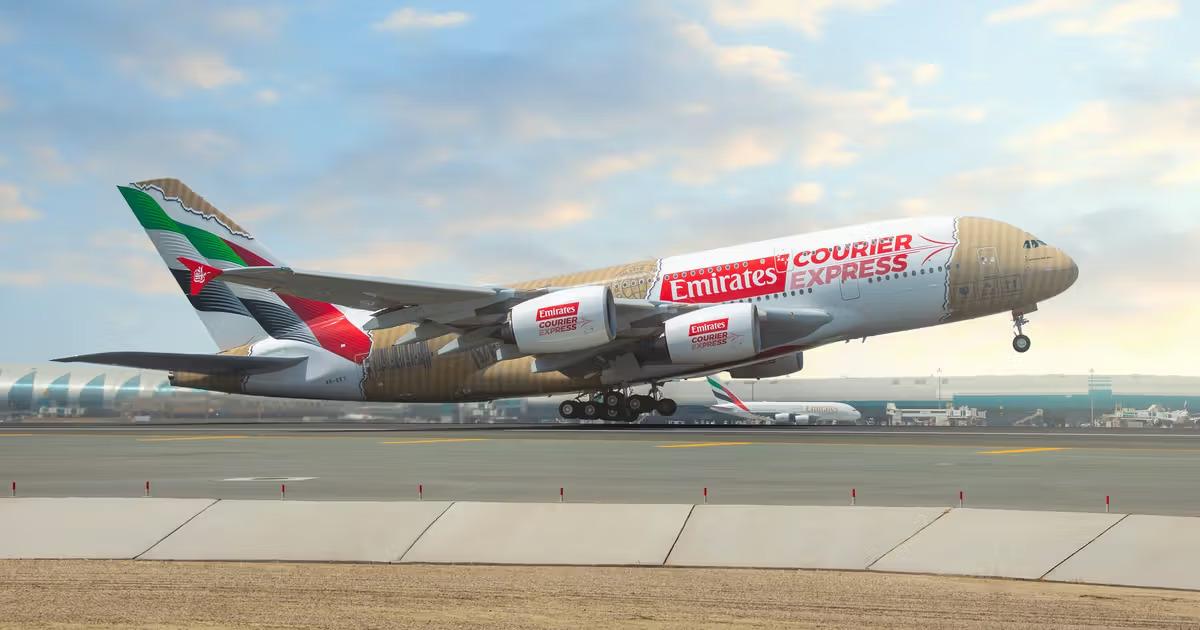
A Dubai-centered logistics model built on Emirates' passenger fleet is making international shipping economics viable for brands that previously couldn't afford to care about smaller markets.
The number that matters here is $10. That is what Mayple Direct — a new logistics service built in partnership with Emirates Courier Express — claims a US brand can pay to ship a package to a customer in the UK and have it arrive in two days. For context, that figure is achieved not through discounting but through routing: instead of a package landing in London, sorting through a hub, and being driven to Manchester, it flies direct to Manchester on an Emirates passenger aircraft and is delivered from there. The infrastructure doing this work is a centralized hub in Dubai, positioned inside the emirate's free zone network, which allows goods to move across borders with minimal friction.
Mayple Global's founder and CEO Ammar Moiz frames the problem his platform addresses as one of access, not ambition. US brands that want to sell internationally are not short of desire — they are short of a workable logistics layer. Domestic fulfillment in the US is a solved problem: dozens of third-party logistics providers integrate with Shopify and handle pick, pack, and ship without a complicated setup. Internationally, the model breaks down. Brands either lean on middlemen acting as international distributors — a structure that adds cost and erodes margin — or they simply do not serve those markets. What Mayple Direct offers is essentially the domestic model replicated globally, with Dubai as the central warehouse rather than a US distribution center.
The aggregate demand argument is the one worth paying attention to. Moiz is explicit: no US brand should be expected to build a dedicated logistics operation for the Kenyan market alone. But aggregate Kenya with a dozen similarly sized markets and, according to the company, those combined markets can represent 25% to 30% of a brand's total international demand. That math changes the strategic calculus. Markets that were previously written off as not worth the operational complexity now become viable line items on a shipping manifest.
Moldova fits squarely into this category of markets that international logistics economics have historically made uneconomical to serve. A US or UK brand looking at Moldova as a destination would face the standard problem: low aggregate volume, complex last-mile delivery, and no local warehousing infrastructure to justify the overhead. The hub-and-spoke model Mayple describes — routing through Dubai rather than back through the origin country — compresses the per-unit cost in exactly the way that makes smaller-volume markets financially defensible. For Moldovan businesses importing goods for resale or operating cross-border fulfillment for niche product categories, a model like this changes the sourcing equation fundamentally.
The tariff bypass dimension adds another layer relevant to the Moldovan import context. One explicit use case Moiz describes is for US brands manufacturing in Asia that previously had to route inventory back through the US before shipping onward — incurring tariffs at each step. A Dubai-based hub allows that inventory to be consolidated and shipped directly to end markets, avoiding the round-trip cost structure. For a Moldovan operator importing specialty goods that pass through multiple jurisdictions before arrival, the same logic applies: the routing architecture matters as much as the declared value of the goods.
Moldova's EU candidate status is also quietly relevant here. As regulatory alignment with EU standards progresses, the customs and compliance framework governing inbound goods is tightening and standardizing. That creates both a challenge and an opportunity for operators building cross-border supply chains: the compliance cost rises, but so does predictability. A logistics model built around direct routing and high deliverability — Mayple reports a 99%-plus deliverability rate and an average of 3.5 days from checkout to doorstep — becomes more, not less, valuable as the regulatory environment formalizes.
For anyone operating in this space in Moldova, three questions are worth sitting with: Does your current logistics setup price you out of serving niche international demand that could represent a meaningful revenue share? Is your routing architecture optimized for cost and speed, or is it simply the path of least resistance you chose when you started? And if the per-unit shipping cost to or from Moldova dropped materially, which product categories would suddenly become viable that are not today?
The closing question is harder: if the logistics barrier to reaching Moldova from abroad falls, how does that change the competitive position of every local operator who has been insulated by that barrier?
Most operators in this space default to whatever freight forwarder they used for their first shipment and never revisit the architecture. The more deliberate path is to pressure-test the routing logic against current hub models — because in international logistics, the default choice is rarely the cheapest one.
SourceSee also

Anne Mahlum's Pilates playbook is a masterclass in capital efficiency. The real lesson isn't inspiration — it's unit economics.
Anne Mahlum turned $175,000 in personal savings into a fitness company that sold for $88.4 million to private equity firm Kohlberg & Company — and was later valued between $600 million and $700 million when L Catterton, backed by luxury goods giant LVMH, acquired a majority stake in Solidcore. In a sector where 81% of health and fitness studios fail in their first year, according to the Health & Fitness Association, that trajectory is not a feel-good story. It is a case study in deliberate market positioning.
Mahlum launched Solidcore in Washington D.C. in 2013 with one studio, no bank loan, and no venture capital — a deliberate choice driven by her read of the competitive landscape. She hit $2 million in revenue in year one at a 50% profit margin, opened a second location within five months, and reached 10 studios within two years. By 2024, Solidcore was projected to generate $50 million in profits on $150 million in revenues across 100 gyms in 27 states. The compounding logic here is straightforward: a replicable operating model, trained instructors who knew every client's name and goals, and a product — high-intensity, low-impact Pilates — that had no boutique-format competitor when she launched.
The deeper insight is not that Mahlum was passionate. It is that she identified a structural gap — no branded boutique Pilates chain existed — and built a standardized operating playbook before she opened studio number two. Passion funded nothing. The $175,000 did. Replicability scaled it.
For anyone operating a fitness or wellness studio in Moldova, Solidcore's capital structure is the most instructive data point. Mahlum bootstrapped entirely from personal savings and reinvested first-year profits to fund expansion — no external equity, no debt beyond the initial lease obligations. In a market where access to growth capital for service businesses is structurally constrained, that sequencing matters: prove unit profitability at location one before committing to location two. A boutique fitness studio in Chisinau carries real fixed costs — lease, equipment, instructor salaries — and the margin math must work at the single-location level before any replication logic applies.
The equipment side of the Solidcore model deserves attention. Pilates-specific resistance machines — the kind Solidcore uses — are capital-intensive imports with no local manufacturing base. Any operator in Moldova building around specialized fitness equipment faces both the upfront acquisition cost and ongoing maintenance dependencies tied to international supply chains. Mahlum leased her first equipment rather than purchasing it outright, preserving liquidity for instructor training and marketing — a financing structure worth examining closely given the import costs and customs exposure any specialized gym equipment faces entering the Moldovan market.
Moldova's EU candidate status is beginning to shift the regulatory and commercial environment for service businesses in ways that are directly relevant to boutique fitness. As alignment with EU consumer-protection and safety standards advances, fitness studio operators face a narrowing window to establish operational practices before compliance requirements formalize. Solidcore's early investment in instructor certification and standardized client protocols — the requirement that every instructor know every client's name and fitness goals — was not just a brand differentiator. It was a quality-control infrastructure that would satisfy any regulatory audit. Building that infrastructure early, rather than retrofitting it under compliance pressure, is the structural advantage available to any operator willing to move deliberately now.
These mechanics raise three questions worth sitting with. Does your current studio model produce a profit at the single-location level that could fund a second location without external capital? Is your equipment and supply chain resilient enough to survive a six-month import disruption? And have you documented your operating playbook in enough detail that a second location could be staffed and run without your daily presence?
Most fitness operators in this market focus on filling classes at location one and treat expansion as a future problem. The operators who build the replication infrastructure — the training manual, the instructor certification standard, the unit-economics model — before they need it are the ones for whom a second location is an execution decision rather than a leap of faith.

Amazon Ads research reveals a structural window in consumer spending that small-market operators consistently underuse.
According to research conducted by Amazon Ads with market research firm Alter Agents, fielded between March and June 2024 across more than 10,000 U.S. respondents, 68% of consumers say life events directly influence their spending habits. Six in ten people said they dedicate more time to product research during these transitions. The finding is not a soft behavioral observation — it is a hard commercial window that consumer packaged goods brands either enter deliberately or miss entirely.
The deeper insight sits beneath the headline number. Expectant parents in the study were 28% more likely to increase their overall spending, 53% more likely to prioritize physical health, and 48% more likely to prioritize family time compared to consumers in other life-event categories. First-time homebuyers, meanwhile, were 20% more likely to seek professional opinions during their purchase journey. These are not incremental shifts — they are category-level resets that make previously locked-in brand preferences suddenly negotiable. Amazon Ads reported reaching more than 80% of baby product shoppers and 86% of household shoppers in the U.S. during these windows, using its demand-side platform and a media network spanning Amazon.com, Prime Video, IMDb, Twitch, and Alexa.
For a CPG operator running distribution into Moldova — whether importing baby-care lines, household cleaning products, or personal care SKUs — the structural argument here deserves serious attention. The life-event window is not an Amazon-specific phenomenon; it is a documented feature of how purchasing hierarchies get rebuilt. The question is whether local distribution infrastructure can actually activate it. Moldova's CPG supply chain is largely import-dependent, which means the brands sitting on local shelves are not always the ones with the deepest marketing investment in the market. A baby-care product placed in a Chisinau pharmacy or a household goods line stocked in a local supermarket chain reaches the same expectant or newly-moved household — but without the real-time behavioral targeting that Amazon's trillions of signals enable, the placement logic has to be solved upstream, at the distribution and category-management level.
This shifts the burden onto how SKUs are actually positioned within retail channels. A local importer handling baby-care or home-care categories who simply replicates shelf arrangements from a Romanian or Ukrainian supplier catalog is not engaging the life-event logic at all. The more defensible position is to structure assortment around transition moments — stocking the research-heavy, safety-adjacent SKUs that new parents reach for when they are actively reconsidering every product, not just cycling through habitual purchases. That requires a conversation with retail partners about category placement, not just invoice terms.
The media consumption data from the Amazon Ads research adds a second operational layer. Expectant parents in the study showed a 19% increase in TV streaming and a 15% increase in music streaming. First-time homebuyers showed a 21% increase in streaming TV. In Moldova's advertising environment, streaming and digital video inventory is available and increasingly accessible to mid-sized advertisers. A local brand or a regional distributor running a campaign tied to a specific life-event category — rather than a generic product push — is operating with a more precise brief and a more defensible media budget.
The research also makes a point about durability: brand relationships formed during these pivotal moments tend to persist well beyond the milestone itself. For operators in a small, loyalty-sensitive market, that compounding effect is arguably worth more per acquisition dollar than any promotional campaign.
Before applying any of this, a few questions are worth sitting with. Does your current SKU mix actually address the shift in priorities — safety, quality, professional credibility — that life-event buyers are moving toward, or does it mirror the assortment logic of stable, habitual purchasers? Is your retail placement structured around category transition moments, or purely around volume and margin? And is your media spend, however modest, timed to intersect with the moments when product hierarchies are genuinely in flux?
Most operators in this space default to volume-driven shelf placement and promotional pricing, which works well for habitual buyers but leaves the higher-value transition window largely untouched. A more deliberate approach starts one level up — at assortment architecture and channel positioning — before a single promotional budget is allocated.

The omnichannel data is sharper than the headlines suggest, and the distribution implications run deeper than any single market.
Half of Gen Z discovers new products through friends, family, or colleagues — not through a feed. A 2025 YouGov study punctures the assumption that younger consumers have abandoned physical retail entirely. While 69% of Gen Z began their decision-making process online, 53% still browsed in stores. And 29% spotted an item online but completed the purchase in-store, while 21% did the reverse. The channel split is not a contradiction — it is the actual shopping architecture of this generation.
The deeper insight is structural. Social media remains the dominant discovery tool for Gen Z, used by 64% compared to 44% of older American adults. But discovery and purchase are not the same event. The YouGov data makes clear that physical presence is not a legacy cost — it is an active conversion layer. Retailers who cut stores to fund digital, or who built digital to avoid stores, are now managing the consequences of that binary logic.
For a retail or distribution operator in Moldova, the omnichannel argument lands differently depending on how the channel mix is currently structured. Most domestic retail formats — grocery, apparel, electronics, personal care — are built around a store-first model with a digital presence that functions more as a catalog than a commerce engine. The YouGov finding that 29% of Gen Z purchases are initiated online but closed in-store suggests that the weakest point in the local chain is often the handoff: a product seen on social media or a website that cannot be located, confirmed, or reserved in a physical outlet.
The capital requirement for genuine omnichannel is not trivial. Inventory synchronization, staff trained to handle cross-channel queries, and a logistics backend capable of same-day or next-day fulfillment are costs that compress margins quickly at Moldova's scale. The businesses best positioned to navigate this are those where the store network already exists and the digital layer can be added incrementally — not those attempting to build both from scratch simultaneously. A retailer operating five or more physical locations, for instance, has a credible foundation; a single-store operator faces a different equation entirely.
The 31% of Gen Z who prefer email for customer service — versus 21% of older generations — points to a secondary pressure point: post-purchase infrastructure. In categories like electronics or fashion accessories distributed in Moldova, the after-sale experience is often the most underdeveloped part of the chain, and it is increasingly where channel preference gets formed.
These mechanics raise specific questions worth sitting with. Does your current digital presence function as a discovery surface or only as a brochure? If a customer sees your product online, how many steps separate that moment from a confirmed in-store transaction? And is your inventory visible enough across channels to support the journey the data describes?
The omnichannel era does not reward those who simply have both a website and a store — it rewards those whose channels actively hand customers to each other.
Most operators here treat digital and physical as parallel but separate investments. The more deliberate path is treating them as a single funnel with two entry points — and building the backend to match.

Jeff Fenster didn't wait for the perfect conditions — he signed the lease before he had a name. That instinct is worth studying.
Jeff Fenster had no brand name, no menu, and no roadmap when he called a landlord about a closing Smoothie King franchise in 2016. He signed the lease anyway. That single decision became Everbowl, an acai bowl chain that now operates 100 locations and counts Jayson Tatum, Drew Brees, and Shaquille O'Neal among its investors. The story travels fast on social media, but the part that gets less attention is what happened between location one and location one hundred.
Fenster's playbook isn't about acai bowls. It's about refusing to let operational friction become a ceiling. When the cost and pace of new unit construction threatened to slow his expansion, he didn't renegotiate with contractors — he launched his own construction company, WeBuild, to streamline Everbowl's build-outs entirely. That's a move most restaurant operators would never consider, not because it's impossible, but because it requires seeing a supply chain problem as a business opportunity hiding inside an inconvenience. The broader principle is harder to replicate than it looks: every constraint Fenster hit became the founding premise of a solution he owned.
The real disruption here isn't the acai bowl format — it's the growth architecture. Fenster treated each new location as a data point on real estate and customer behavior, building institutional knowledge into the brand itself rather than outsourcing those lessons to brokers and consultants. He also reframed competition: the threat to Everbowl wasn't the bowl shop across the street, it was every other claim on a customer's lunch budget. That mental shift changes how you design a value proposition entirely.
For anyone running a food business in Moldova — whether a fast-casual concept in Chisinau, a regional bakery chain, or a delivery-first kitchen — the structural tension Fenster navigated is not unfamiliar. The Moldovan food market is young enough that format advantage still matters, but mature enough that the operators who built early loyalty are now defending it against newer entrants with sharper branding and lower price points. The question is whether growth, when it comes, will be managed deliberately or absorbed reactively. There are patterns worth examining honestly here. When a local food operator hits a bottleneck — a supplier who can't scale, a fit-out process that drags for months, a location that underperforms — the instinct is usually to treat it as a cost to absorb. Fenster treated the same type of problem as a vertical to own. The gap between those two responses is where competitive distance gets built. Before assuming your next constraint is just friction to endure, it is worth asking yourself: Is the thing slowing my growth something I could solve once and turn into an advantage? Am I defining my competition by category, or by what my customer could spend their money on instead of me? Does each location I operate teach me something specific about where my next one should be — and am I capturing that learning? These aren't questions with clean answers, but they're the kind a business looks different after asking.
What decides the next chapter for food operators in Moldova isn't capital or concept — it's whether the person running the business treats problems as interruptions or as raw material. Most operators in this space manage constraints as they arrive, one at a time, without building anything structural from the experience. The ones who end up with something that compounds tend to pause longer on each friction point — not to complain, but to ask whether it's also a door.

When the world's most iconic luxury category loses its pricing power, the ripple reaches every market that carries it.
Natural diamond prices have fallen 26% over the past two years. Lab-grown diamonds have dropped 74% in price since 2020. Against that backdrop, De Beers and the Government of Botswana announced a co-funded category marketing initiative designed to restore the perceived value of mined diamonds — with financial responsibility split according to each party's share of Debswana's diamond supply. It is a significant bet on narrative over fundamentals.
The numbers behind the announcement are stark. In 2024, De Beers' rough diamond sales fell for the second time in the year, recording a provisional $315m — down from $383m in the previous cycle and a steep drop from $456m at the same point in 2023. The company attributed part of the decline to a quieter summer period, but industry analysts pointed to something more structural: a market where demand has not recovered and where lab-grown alternatives have permanently repositioned the category's price ceiling.
The deeper story is not about marketing budgets. It is about what happens when a product that derived its value almost entirely from scarcity and symbolism collides with a scalable, cheaper substitute. De Beers built one of history's most durable brand narratives around natural diamonds. Now it is being asked to rebuild that narrative in a market where a lab-grown stone is visually and chemically identical to a mined one — and costs a fraction of the price. That is not a communications problem. It is a value-proposition problem that marketing can slow but not reverse.
For a jewelry retailer or goldsmith operating in Moldova, this global price collapse creates a specific operational problem: inventory valuation. Natural diamond pieces purchased at 2022 or 2023 wholesale prices are now sitting on shelves against a market where replacement cost is materially lower. A retailer who bought inventory at the peak is not just facing a margin squeeze — they are facing a structural mismatch between their cost base and what the current wholesale market would imply as a fair price for that product.
The competitive pressure runs in both directions. On one side, internationally sourced lab-grown diamonds are entering the European market at price points that make natural stone pieces look expensive by comparison. Moldova's EU candidate status means that import channels from EU-based distributors are becoming more accessible, which accelerates the arrival of these products into the local supply chain. A goldsmith in Chisinau who sources exclusively through traditional natural diamond wholesalers will face growing price competition from pieces carrying stones that are chemically identical but priced off a completely different cost curve.
On the supply side, the De Beers and Botswana marketing initiative is explicitly a category play — meaning its benefits, if any materialize, will accrue to the entire natural diamond segment, not to any single retailer. A small jewelry operation in Moldova will not be a direct beneficiary of that campaign spend. What it can do is position its natural diamond inventory around the ethical and provenance arguments that the campaign is designed to amplify — certified origin, traceability, the social and economic weight of the mining economies behind the stone. That is a pricing-support argument, not a volume argument, and it requires a different kind of sales infrastructure than most small jewelers currently maintain.
Anyone carrying diamond inventory right now should be asking themselves three questions. First: at what wholesale price was my current stock acquired, and does my current retail pricing still reflect a defensible margin given where natural diamond replacement costs sit today? Second: does my supplier base give me access to lab-grown product if segment demand continues to shift, or am I structurally locked into one side of a bifurcating market? Third: is my current merchandising built around the symbolic and provenance story that the De Beers campaign is trying to reinforce, or is it built around a price-to-size value equation that lab-grown stones will win on every time?
Most jewelry operators in this position default to holding inventory and waiting for prices to stabilize. A more deliberate response is to audit the cost basis of existing stock now and decide, before the next buying cycle, which part of the portfolio is positioned to hold value and which part needs to be repriced or liquidated.

When budgets tighten, consumers don't eat less — they eat differently. That distinction matters more than most local operators realize.
Seventy-four percent of consumers say they will return to a restaurant after a unique experience. That single figure from a SevenRooms study is worth sitting with, because it reframes the entire conversation about what the restaurant business actually sells. It is not food. It is not even service. Increasingly, it is memory.
The Yelp data from the first quarter of 2025 makes the shift concrete. Searches for Le Petit Chef — an immersive dining concept that projects a 6-centimeter animated chef onto diners' tables using 3D technology — were up 509% during that period. Searches for hibachi catering jumped 55%. Chef's table searches rose 36%. Meanwhile, Technomic's 2024 Top 500 data showed that concepts built around participation and theatre outpaced the industry's average growth of just above 3% by a wide margin. KPOT Korean BBQ & Hot Pot, which lets guests cook their own food in an interactive all-you-can-eat format, grew sales 34% to $398 million. Puttshack, a tech-integrated mini golf and dining concept, posted 60.2% growth to reach $32.2 million. Cooper's Hawk, built around a wine club with tastings and members-only events, grew 12.5% to $605.3 million. Kura Sushi's revolving bar drove a 27% year-over-year sales increase to $237.8 million. The pattern is consistent: when people feel the pressure of tighter budgets, they do not stop going out — they become more deliberate about where they go, and they are willing to pay for something that feels worth the occasion.
The instinct in a small market like Moldova might be to read this as a story about scale — that immersive projection systems and revolving sushi conveyor belts belong to another world entirely. That instinct is understandable but probably wrong. The underlying dynamic translates directly into the Moldovan dining sector, where the gap between a transaction and an experience is arguably wider than anywhere in the region, and therefore the opportunity is proportionally larger.
Consider what the data is actually describing: people spending carefully but spending willingly when a restaurant gives them a reason beyond the plate. A family-run restaurant in Chisinau does not need $32.2 million in infrastructure to create a format guests remember. A wine evening with a small producer, a live cooking station at the table, a fixed menu built around a single seasonal ingredient — these are formats, not investments. The question for any operator here is whether the business is designed around the meal or around the visit. Those are genuinely different propositions, and the market increasingly rewards the second one. Before deciding which direction to move, it is worth pausing on a few uncomfortable questions that the data quietly raises. Is the current format giving guests something to talk about afterward, or just something to eat? When a customer chooses this place over a competitor, is the reason the food, the price, or the feeling of the evening? And if the experience element were removed entirely, would the core offering survive on its own merits?
The question worth carrying out of this conversation is simpler and harder at the same time: in a market where most restaurants are still competing on price and portion size, what would it actually take to be the place people plan their week around?
Most operators in Moldova's dining sector default to competing on menu breadth and value — a rational response to a price-sensitive market. But the operators who are paying attention to the shift described above are starting to design around the visit itself, treating the experience as the product and the food as its most important component.